


Car Diagnostics
Testing that helps identify the cause of a warning, symptom, no-start, or electrical concern before repair.
Read more ›Mercedes-Benz is the brand Gonzalez Auto Mechanic was built around - and the brand with the deepest specialist experience in the shop. The lineup spans more vehicle categories than any other German manufacturer: the compact A-Class and CLA, the volume-selling C-Class and E-Class, the flagship S-Class, the GLA / GLB / GLC / GLE / GLS / G-Wagen SUV family, the AMG GT performance line, the SL roadster, the Sprinter and Metris commercial vans. Each platform has its own service personality.
Mercedes-Benz repair for Wilmington and nearby communities
What separates Mercedes work from generic auto repair is the combination of brand-specific fluids (MB-Approval 229.51 / 229.71 engine oil, MB 236.15 transmission fluid, MB 325.5 coolant), brand-specific diagnostics (the Xentry / DAS system that talks to every control module from Distronic radar to the AIRMATIC compressor), and brand-specific service procedures. Trying to service a modern Mercedes with universal parts and a generic OBD-II scanner usually causes more problems than it solves - a 2015 E-Class has more than 40 control modules talking on the CAN bus, and almost every replacement part requires coding to the vehicle's VIN before it functions correctly.
The engineering culture is conservative-but-complex: Mercedes will keep core components in production for a decade and engineer them for a 300,000-mile service life, but they pack each platform with adaptive control systems that need precise diagnostics when something does fail. Stay on the Service A / Service B schedule, use MB-approved fluids, fix small leaks before they become big ones, and a Mercedes will run 250,000+ miles with the kind of refinement only this brand delivers. Skip the schedule and the repair bills compound fast.
Mercedes service runs on the dealer's Service A / Service B framework, and the schedule isn't optional on these platforms.
Service A is roughly annual or every 10,000 miles. It's the basic interval: MB-approved full-synthetic oil and filter change (the 229.71 oil approval is required on most current gas engines - using the wrong oil triggers oil dilution and timing chain wear warnings), cabin air filter, brake inspection, fluid top-ups, and an A-service scan to clear the maintenance counter and check for stored fault codes across all modules.
Service B is roughly every other year or 20,000 miles. Adds a brake fluid flush (mandatory every 2 years - the electro-hydraulic brake systems on E-Class and S-Class are extremely sensitive to moisture-contaminated fluid; ignored brake fluid can contribute to ABS pump failures), spark plug replacement on gas engines at the model's interval (usually 60,000-100,000 miles depending on platform), a deeper multi-point inspection, and air filter service.
Beyond the A/B framework, several services Mercedes used to call "sealed for life" actually need attention: the 722.9 7G-TRONIC and 725.0 9G-TRONIC automatic transmissions benefit from a 60,000-mile fluid and filter service. The 722.9 in particular has a known wear pattern on the conductor plate inside the valve body when old fluid stops insulating properly. The coolant must meet the vehicle's factory requirements. Service timing and method depend on the model, history, and coolant condition; old or incorrect coolant can contribute to corrosion.
Diesel-specific (Sprinter, Bluetec, OM642 / OM651 / OM656): fuel filter replacement on the factory schedule is critical - Sprinter fuel filters often hide water-separator drain points that owners never check until the high-pressure pump fails. AdBlue (diesel exhaust fluid) tank top-ups, NOx sensor health, and active regen cycle completion all need monitoring; a chronically incomplete regen cycle eventually clogs the DPF and costs thousands to replace.
Premium 91+ octane is required on every gasoline Mercedes, not recommended. The direct-injection systems on M274, M276, M278, M256, and AMG M177 / M139 engines have aggressive timing and high cylinder pressures - running 87 octane causes long-term carbon buildup, knock, and eventual injector and piston damage. Skipping the required octane is a costly mistake.
SYSTEM-FOCUSED SERVICE
A replacement control unit for a Mercedes-Benz must match the vehicle and the confirmed fault. We review identification and compatibility before programming or installation work begins.
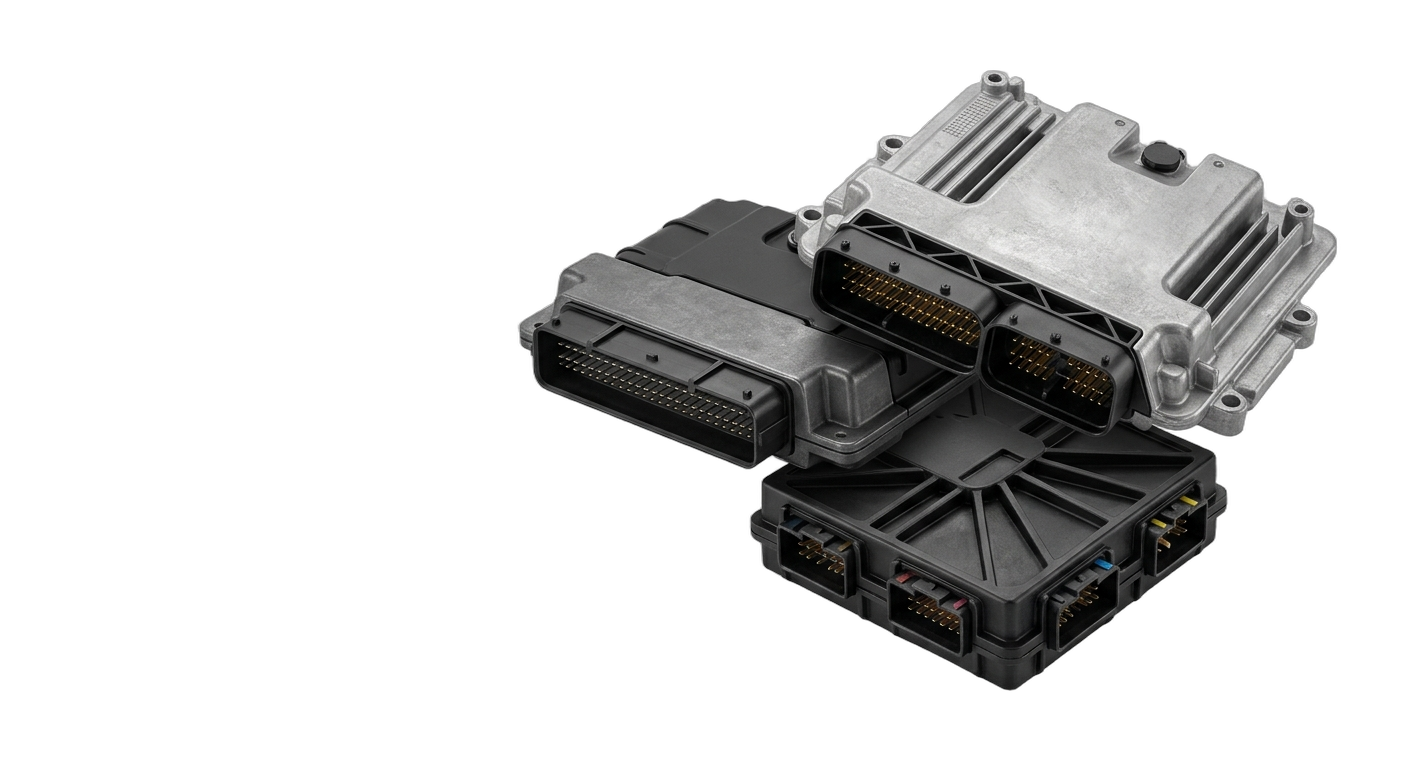
Mercedes-Benz repairs follow well-known patterns by engine family and model generation. Climate and stop-and-go traffic accelerate certain failures, especially on cooling, suspension, and electrical systems. The repairs below are documented failure modes for these systems and generations, not theoretical possibilities.
Mercedes-Benz repairs are predictable when you know the platform. The right tools, the right MB-approved parts, and accurate diagnostics turn most of these into routine work rather than emergencies.
For supported Mercedes-Benz vehicles, module requests may involve engine and transmission controls, body modules, steering-lock or immobilizer systems, and gateways. We diagnose the fault and review the exact vehicle and part before recommending replacement, programming, coding or adaptation. Bring the Mercedes-Benz to the shop for this work.
See ECU & Module Diagnosis, Replacement and Programming for the full service scope and terms.
YOUR NEXT STEP
Choose a preferred day and arrival window online. The shop will follow up during business hours to confirm it.
The M272 V6 and M273 V8 used from 2004 to 2011 across the C, E, S, CLK, SLK, ML, R, GL, CLS, and SL lines can wear the balance shaft gear (V6) or idler gear (V8), the most-known Mercedes engine fault of that decade. It usually announces itself as a check engine light with cam timing codes rather than any noise or change in how the car drives. Since those codes also have cheaper causes, the diagnosis should be confirmed first; if the gear is worn, plan the repair promptly so metal debris does not spread through the engine.
Yes, rough shifts and limp mode on the 722.9 7G-TRONIC usually trace to its 13-pin connector and the conductor plate, often because a leaking pilot bushing lets transmission fluid wick into the connector and wiring. Fluid, the connector, and the conductor plate may be involved, but the repair should follow testing rather than a preset parts list. And despite the sealed-for-life label, these transmissions benefit from a fluid and filter service around every 60,000 miles, which heads off much of this.
A corner that sits low by morning is the classic AIRMATIC symptom, common past 80,000 miles on S, E, GLE, GL, and GLS models. The usual failure points are a leaking air strut, the valve block, the compressor and its relay, or a height sensor, and Xentry diagnosis identifies which one before any parts are replaced. Do not keep driving with a compressor that runs constantly to keep up; it overheats, and one leaking strut becomes a strut plus a compressor.
Probably not, and that exact story on the M112, M113, M271, and M272 engines is the signature of a failing crankshaft position (CKP) sensor, one of the problems most often misdiagnosed as a fuel pump on these cars. The sensor drops its signal once it is heat-soaked, the engine cranks without firing, and after it cools everything works again. The episodes become more frequent until the car will not start at all, so ask us to test the CKP sensor before anyone sells you a fuel pump.
Yes, for supported Mercedes-Benz vehicles and modules. We diagnose the fault and review compatibility before recommending replacement or programming, and the vehicle must be at the shop. See our ECU & Module Diagnosis, Replacement and Programming service for the full scope.
Testing that helps identify the cause of a warning, symptom, no-start, or electrical concern before repair.
Read more ›System-level repair for soft pedals, leaks, warnings, changed stopping, calipers, hydraulics, and ABS concerns.
Read more ›ECU and control-module diagnosis, replacement and programming for supported Audi, BMW, Mercedes-Benz and Volkswagen vehicles. Porsche may be accepted after compatibility review.
Read more ›