


Car Diagnostics
Testing that helps identify the cause of a warning, symptom, no-start, or electrical concern before repair.
Read more ›Jaguar occupies a niche corner of the European luxury market - British heritage engineering with a performance-and-elegance positioning that sits between Mercedes refinement and BMW dynamics. The current lineup centers on the F-Pace SUV (the volume seller), the smaller E-Pace, the XF and XE sedans (production winding down), and the F-Type sports coupe. The XJ flagship is discontinued. Most modern Jaguars share parts and platforms with Land Rover under the Jaguar Land Rover (JLR) umbrella, so service knowledge and patterns translate directly between the two.
The engine families that matter on a Jaguar are the AJ-V8 (5.0L supercharged V8 on F-Type R, XJR, and older XF/XK), the 3.0L AJ126 supercharged V6 (F-Pace, XF, XE), and the more recent Ingenium family - 2.0L turbo four-cylinder (Ingenium I4, P250/P300) and the 3.0L Ingenium inline-six (P400) that powers the modern XF and F-Pace performance variants. Each has its own service personality and a known list of failure patterns.
Jaguar ownership rewards specialist knowledge. The 5.0L supercharged V8 in particular is mechanically complex and unforgiving of skipped maintenance - supercharger snout bearing wear, timing chain tensioner issues, and oil cooler line failures are all common past 80,000 miles. Jaguar owners benefit from proactive service since most repairs are easier to catch early than to fix after the fact.
Jaguar service intervals follow the JLR factory schedule (Jaguar Land Rover unified system).
Jaguar uses JLR-approved synthetic oil - Castrol Edge Professional A5 0W-20 on most current Ingenium engines, 5W-30 on older AJ-V8 supercharged engines. Service interval is 10,000 miles according to the factory schedule, but 7,500 miles is better for high-mileage life, especially on the supercharged variants where oil also lubricates the supercharger snout bearing.
60,000 miles on Ingenium engines, 100,000 miles on AJ-V8 (NGK iridium or factory-approved). Direct injection on Ingenium engines makes timely replacement important.
Every 2 years on Jaguar's schedule. Modern Jaguars with electronic brake systems are sensitive to moisture-contaminated fluid; ABS pump failures from old fluid are expensive.
The ZF 8HP automatic in nearly every modern Jaguar (since 2010) needs fluid + filter service every 60,000-80,000 miles using ZF-approved ATF - same service as BMW. Skipped service causes valve body wear and harsh shifts. The older 6HP transmissions on pre-2010 XF and XK need similar attention.
The Eaton supercharger uses its own gear oil (separate from engine oil). Service interval is 100,000 miles - Jaguar specifies it as "lifetime" but the gear oil degrades with heat cycling. A supercharger noise after 80,000+ miles usually means the gear oil should have been changed.
We use the correct JLR coolant and follow the vehicle's maintenance information. Draining the old coolant and refilling with the correct coolant helps protect the cooling system and supercharger heat exchanger.
Premium 91+ octane is required on every gasoline Jaguar - non-negotiable on supercharged variants. Running 87 octane causes knock and long-term damage.
SYSTEM-FOCUSED SERVICE
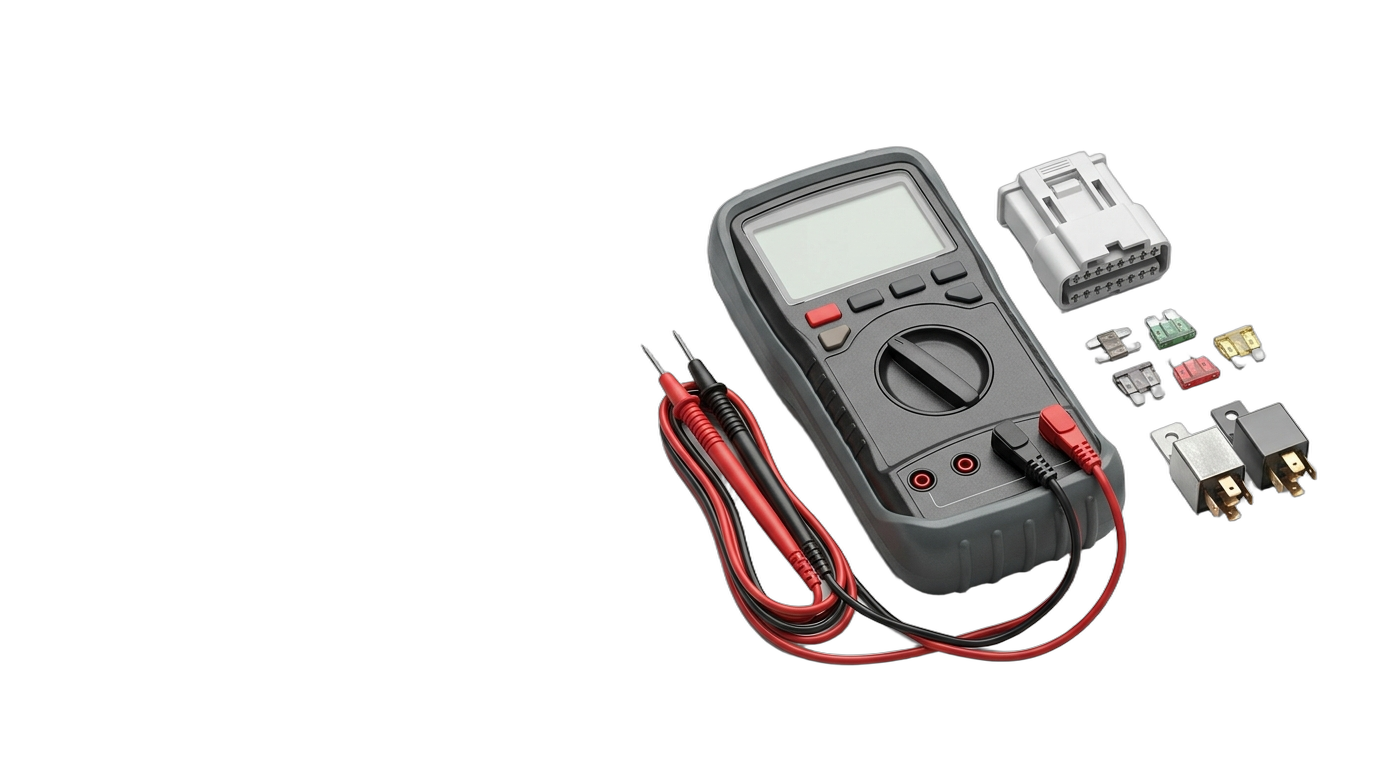
A warning, intermittent fault or no-start on a Jaguar can begin in more than one circuit. We use the symptom, scan data and direct measurements to narrow the cause.
Jaguar repairs concentrate around the engine and the supercharger ancillaries on V8 and supercharged V6 models. Body and electrical issues add up on older XF and XJ generations.
Jaguar repairs are expensive when ignored but predictable when caught early. The supercharger ancillaries and oil/coolant integrity are the difference between a Jaguar that runs 200,000 miles and one that becomes uneconomical to fix at 120,000.
YOUR NEXT STEP
Choose a preferred day and arrival window online. The shop will follow up during business hours to confirm it.
On the supercharged AJ-V8, a whine that rises with engine speed after 80K miles usually points to the supercharger snout bearing, the best known wear point on these engines. The supercharger gear oil is sold as a lifetime fill, but it degrades and deserves service around 100K miles. At the whine stage it is a manageable snout service; ignored long enough it progresses to oil consumption and outright failure, so it is worth bringing in for a listen soon.
The ZF 8HP is a strong transmission, but the smart practice is a fluid and filter service in the 60K to 80K mile window, the same approach used on the BMWs that run this gearbox. Fresh fluid protects the valve body and clutch packs, which are the parts that wear first. Waiting for shifting symptoms means the wear has already started, so service it by mileage rather than by feel.
Usually not. InControl freezes on the XF and F-Pace are a well documented software issue, and current software and a proper reset may help when testing confirms a software-related cause. If it still locks up after the updates are applied, then the unit itself deserves a closer look. Start with software before replacing parts.
Past 70K miles the usual source is worn front control arm bushings, a routine wear point on these cars. The rubber softens and cracks, letting the arm knock over bumps and making the steering feel vague. It is a wear item rather than an emergency, but tired bushings speed up tire wear and only get louder, so plan the repair instead of living with it for years.
Testing that helps identify the cause of a warning, symptom, no-start, or electrical concern before repair.
Read more ›System-level repair for soft pedals, leaks, warnings, changed stopping, calipers, hydraulics, and ABS concerns.
Read more ›A European-vehicle specialty hub for choosing the right diagnostic, repair, or maintenance path.
Read more ›